
We have a lot of planning discussions with our clients.
Selling your home and buying can be stressful, but it doesn't need to be. With a plan in place, you will be stress-free, and successful. That's where we come in.
Knowing to buy or sell first is very circumstantial and depends on many factors...
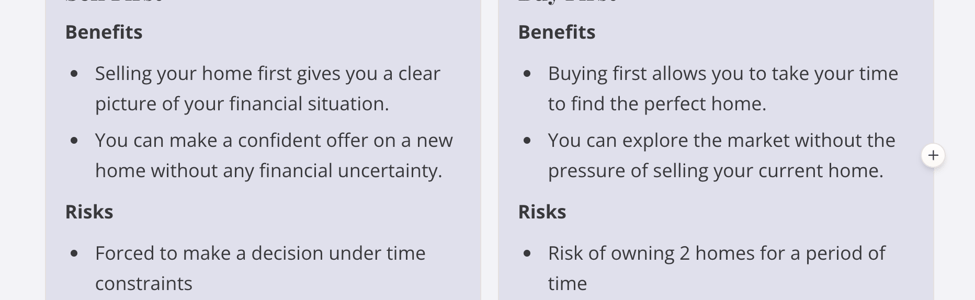
We like to recommend in a buyer's market that you sell your home first before buying your next home. You would ideally sell with a longer closing, 3-4 months. Selling first guarantees you less financial stress so that you know the exact figures.
But maybe you:
- Dont want to be stuck without an option to purchase, or feel rushed to have to make a purchase.
- Have a very specific requirement for your purchase that rarely comes onto the market.
- Have to sell at a certain time to align with a job or your children's school years.
We like to make two recommendations if any of the above apply to you:
- Make offers on the properties that you like (maybe use the condition of selling your existing property in the offer
- Take a worst-case scenario number for what your current home is worth, and use that as the benchmark for your decision making in order to move forward with purchasing first.
By contrast, We like to recommend in a market with tight inventory (seller's market) that you buy your next home first before selling your home. We can essentially have your existing home prepared and on the market within 10 days of you purchasing your new property (staging included). Purchasing first guarantees you won't need to find short-term accommodations if you're not able to locate/ lock down a property during the closing period of your sale.
Lastly, you may want to be asking your bank some of the essential questions to make sure you have a good plan in place, find our recommended list of questions here. https://buschteam.ca/b/blog/buyers/questions-for-your-lender.html
Bridge loan - You will want to ask your bank to approve you for a bridge loan, this is a period of time that you will carry 2 mortgages. The reason that you will want to secure this is two-fold:
1. Allows flexibility when you are arranging your closing dates on the purchase and sale
2. In a perfect world you wouldn't want to close both properties on the same day, its stressful, between getting out of your old home, cleaning it, movers, ect, its hectic! What we like to suggest is that you give yourself a 4-5 day buffer where you close on your new home first, and then close your existing home after. The nice thing too is that when youre selling, you get to guide your winning offers towards the terms that you prefer. i.e. closing date.
Deposits - If you are buying first, please arrange to have approximately 5% of your budget in your chequing account. This Will allow you to put your deposit down on the deal that you write. Sometimes in a competitive situation you would place the deposit with the offer (if you dont get the house you dont submit the deposit) At the very latest you would be submitting the deposit within 24 hours of acceptance of the offer.
If funds are coming from different places to do the deposit then I’d say to start putting them in the same place now so that they’re readily accessible for when the deposit is due. Do you bank with a regular bank? Simplii and ING ect don’t have bricks and mortar locations so if you bank with them maybe transfer the funds somewhere so that the money can be accessed within 24 hours of acceptance of your offer via a bank draft.
FYI the deposit is different from the down payment. Well, sort of one and the same. The deposit is what you place on the property to lock in the deal with the listing brokerage. The deposit is a credit toward the entire downpayment. The lawyers you use to close the deal will be aware of this and will apply the credit toward the purchase/ down payment amount.
HELOC for deposit
If your situation does not allow for a 5% deposit as you would need the funds from your sale in order to place a deposit on a new property, talk to your bank about getting a line of credit in order to make this plan work.
For more information on the matter, see Royal Lepage's article: Buy or sell first?
In tighter markets with rising interest rates and higher costs of borrowing the negotiating power usually falls with the buyer. At this time a different approach to purchasing can be utilized. Talk to us about our strategies and thoughts.